
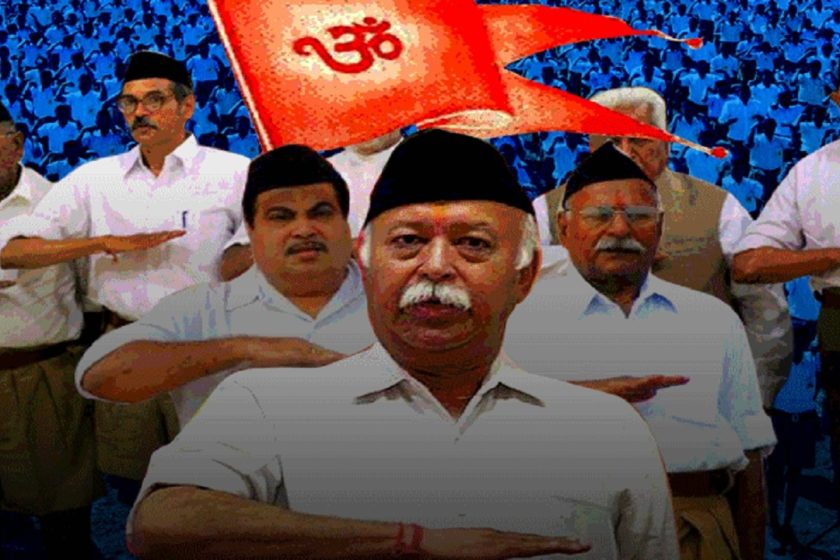
Should HinduSamaj expect SanghPariwar to protect Dharma

After the Bharatiya Janata Party victory in 2014 General elections, fault lines started appearing in the united right wing that actively campaigned and propelled NarendraModi to the Prime Ministership. The days that followed presented a rude shock to many who believed that a Swayamsevak who claimed to be a Hindu nationalist will actively pursue the Hindutva agenda and uplift Hindus from all evil, especially from the attack and loot on their temples and protect the cows from slaughter. What happened was not only neglect but intentional insult as per many devout Hindus. Narendra Modi grandiosely proclaimed that Islam is the Religion of peace and GauRakshaks were termed as rowdies on Saffron robes.

For the devout Bhakts, it was all part of a grand strategy, but to many the strategy was the same as that used by many political parties and is called appeasement. As we stand 3.5 years into the tenure of Narendra Modi and 91 years into the formation of Rashtriya Swayam Sevak Sangh, it will be worthwhile to have an independent appraisal of the ideology and the organizations which many thought will turn India into a Hindu Rashtra.

It will also be interesting to know how and why the RSS terms every other Hindu organization outside its control as fringe. The reason for this is that like all “mainstream” Hindu organizations, they will never support a thoroughly reactionary, hardcore, staunch Hindu uprising. Take the US 2016 elections, for example; did any us notice just how many conservatives and Republicans said no to Trump, or just how many of them sided with Hillary? The reason for that is also the same. Those who are entrenched and recognized cannot entertain something that is genuinely meant to bypass them and not seek their approval for ascendance. The devotion to the cause never matters in their scheme of things.

When the Rakesh Sinhas of the world [Senior RSS ideologue, also Heads the India Policy Foundation] decry Hindu rituals as superstitious, “you” have to take a step back and ponder over the mindset of fellow “allies”. And here “you” mean those conscious of the historical fact that paganism in Europe, for example, was literally murdered first and foremost through the banning of heathen rituals, shortly followed by the wholesale destruction of pagan temples.

Now, this is not to say that the RSS is “bad”. It has done a whole lot of good, and continues to do much good for Indians. And that’s just it, it does good for Indians, not Hindus. As a disaster relief organization, the RSS is quite phenomenal, always the first to show up when a natural calamity happens or a social tragedy happens and help Indians out. Some Hindu-centric approaches have also been made by the RSS through Gharwapsi operations. But that does not mean that the RSS will help Hindus to reclaim their temples, or support staunch Hindus or Hindu organizations make Bharat into the Hindu Rashtra that was once graced by the footsteps of Lord Shri Rama, the best of men, a scourge to his enemies, and the most resplendent.

We have never thought how important of a movement to Reclaim Hindu Temples truly is (the movement to reclaim all Hindu temples that was seized by Muslim invaders and presently used as Masjids, and the movement to rebuild all the destroyed temples of Bharat) and the sheer veracity of such a movement. It is not for the faint-hearted, and is certainly not for anyone who would compromise wíth respect to Dharma. Therefore, it is sadly not for the RSS either. How so? Because the average RSS ideologue, regardless of how “communal” he or she truly may be, still believes in non-sequitorial reasoning like “Hindu-Muslim Bhai Bhai” and utters absurdities like “pseudo-secularism”. Pray, tell me, what in the world is “pseudo” about secularism? Absolutely nothing. “There is nothing ‘pseudo’ about secularism—it is at its most genuine when compelling Hindus to think thoughts that are not their own.” And their co-brothers in Bharatiya Janata Party now are proponents of “SarvaDharma Samabhavana” another word they coined which will translate into pseudo secularism which they are dead against. Organising Iftar for Muslims and hobnobbing with Bishops and sometimes lying at their feet as the BJP Kerala President did is the new Hindutva rituals Sangh ideologues and leaders now follows to establish a Hindu Rashtra.

To offer an example: We once had a Rgvedic king named Trasadasyu. How many of us have heard of this name? It can be translated, in quite a literal sense, as “Before whom the Dasyu trembles”. In other words, before whom the consumer of cow-flesh trembles, before whom he who does not believe in the gods and goddesses of the illustrious ancestors trembles. We once had such a king. And the manifestation of the attempt to transform Bharat into a Hindu Rashtra and reclaim all its temples is a manifestation of that great Vedic king of old.

On other side we have a Rakesh Sinha who tells us to downplay ritualism and the average RSS member still thinks there can be compromise of our rituals as also the Hindu Dharma to accommodate Muslims and Christian sensitievities. Those who are very covetous of their current positions will certainly not be fond of a resurgent Trasadasyu.

And we can safely say that like all “mainstream” Hindu organizations “acknowledged” by the Indian secular government, Rashtriya Swayamsevak Sangh and its overgrown family is one that cannot, and should not be relied upon for the main concern of making Bharat into a Hindu Rashtra, let alone reclaim its temples.
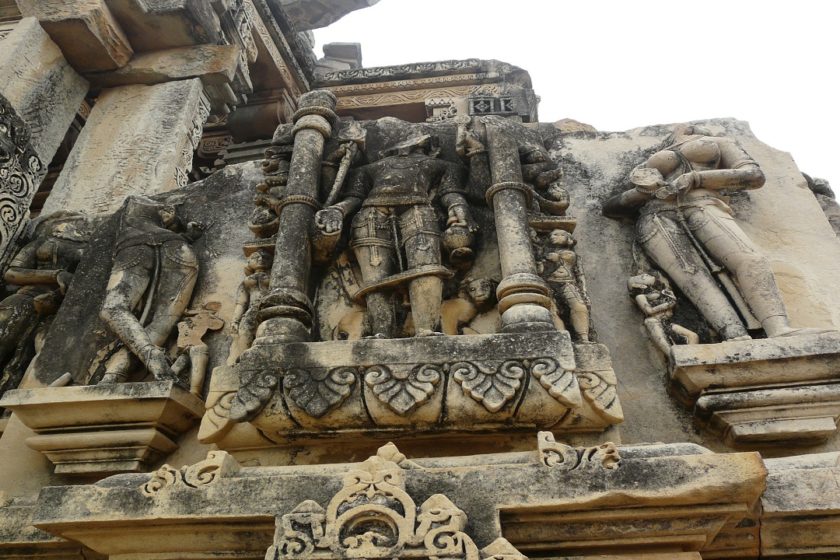
Destruction of Hindu Temples by Muslim invaders

Article by @OGSaffron

Little discussed or highlighted is the psychosocial aspect that accompanied most of, if not all, the instances wherein Hindu temples were destroyed. As Jonsson (2006) points out: When “Muslim invaders broke and burned everything beautiful they came across in Hindustan,” they were “displaying the resentment of the less developed warriors who felt intimidated in [their] encounter with a more refined culture” (p. 86).

Indeed, for the Muslim invaders, the Hindu infidels—these “refined” pagans, the Kafirs—were “heathens, par excellence” (Jonsson, 2006, p. 86). Therefore, how could they build such extravagantly ornamented, finely constructed buildings if they were not Muslim? Are not the infidels supposed to be inferior in every respect to the zealous believer, to those who do not join other gods with the One True God?

When one examines the many architectural remnants that have survived in their “hybrid” form—as even the politically correct archaeologists would have us believe in “fusions” of Dharmic and Islamic “architecture” being congregational and intercultural rather than ferocious and resentful—visible is the mosque type that is the conquest mosque. The foundation of such “hybridity” is not the benign intercultural notion that secular ideologues would have us accept but instead a profound hatred of the Hindu and his place of worship. Almost every “hybrid” expression that has come down to us surviving in the form of the conquest mosque is a religious declaration, through architectural continuity, of Muslim superiority over Hindu heathenry.

To define the common feature of such “hybridity” is to capture the essence of the conquest mosque. Mosques of conquest are “mosques that are all built on the sites of dismantled temples and employ recut columns and other spolia taken from the destroyed monument” (Wagoner & Rice, 2001, p. 90).

To give an example, take for instance the inscription on the eastern gate of the Quwwat al-Islam mosque—a conquest mosque that stands as the “Might of Islam”—which records “that the mosque was built with spolia taken from twenty-seven different temples; these spolia include columns, bracket capitals, ceiling panels, and other decorative members, and the mosque can be seen to be founded on the plinth of one of the destroyed temples” (Wagoner & Rice, 2001, p. 90).

The usage of spolia from destroyed Hindu temples in the construction of conquest mosques, often on the sites of dismantled Hindu temples, is not entirely a matter of convenience and/or intercultural sharing, as secularist and Marxist historians often argue.

On the contrary, conquest mosques project quite vividly “the ghazis’ attitude toward the Hindu majority” based on “the virtues of [their] belief in Islam” where “the need to reinforce the spiritual and political authority of Islam through architecture” is in direct response to “the evils of idolatry and polytheism” (Welch & Crane, 1983, p. 124). Take, for example, Firuz Shah Tughluq’s assertion of Muslim orthodoxy when personally destroying the images of Hindu gods. These images “were burned in a place otherwise reserved for public executions and the punishment of criminals” (Flood, 2002, p. 648). The images of Hindu gods were destroyed, desecrated, or mutilated not only because of anti-heathenry, but also on the little discussed insight that the images represented the potency and purposefulness of a very sophisticated non-Muslim civilization that challenged the religious primacy of an Abrahamic faith whose zealous followers emphasized the superiority of its anti-idolatry creed (Wink, 1997). To render the idols powerless was to wash away the intimidation and shame brought on from encountering a more refined culture.

Therefore, the architectural patronage of Muslim sultans so incessantly praised by the rewriters of history is instead, and can be captured more realistically as, the religious declaration of Muslim supremacy over the nonbeliever, where Islam has been triumphant and idolatry has been subdued (Welch, Keshani, & Bain, 2002, p. 33). After all, “Muslim ghazis had brought the Jihad to India” (Welch et al., 2002, p. 31). And with that came the destruction of places of idol worship, and establishing “the foundation of congregations of Islam” in systematic fashion (Welch et al., 2002, p. 33).

To such a zealous mind, experiencing the existence of sophisticated heathenry, represented herein by the Hindu architectural tradition, was discontenting. As Lord Byron (1847, p. 293) put it: “They have raised a mosque…[and] they are not contented with their own grotesque edifice, unless they destroy the prior and purely beautiful fabric which preceded, and which shames them and theirs for ever and ever.”


Byron, G. (1847). Letter to John Murray on the Rev. W. L. Bowles’s strictures on the life and writings of Pope. In F. G. Halleck (Ed.), The works of Lord Byron; In verse and prose (p. 293). Hartford, CT: Silas Andrus & Son. (Original work published 1821)
Flood, F. (2002). Between cult and culture: Bamiyan, Islamic iconoclasm, and the museum. The Art Bulletin84(4), 641–659. http:/dx.doi.org/10.2307/3177288
Jonsson, D. (2006). Islamic economics and the final jihad: The Muslim Brotherhood to the Leftist/Marxist Islamist alliance. Maitland, FL: Xulon Press.
Wagoner, P., & Rice, J. (2001). From Delhi to the Deccan: Newly discovered Tughluq monuments at Warangal-Sultanpur and the beginnings of Indo-Islamic architecture in southern India. Artibus Asiae61(1), 77–117. http://dx.doi.org/10.2307/3249963
Welch, A., & Crane, H. (1983). The Tughluqs: Master builders of the Delhi Sultanate. Muqarnas1, 123–166. http://dx.doi.org/10.2307/1523075
Welch, A., Keshani, H., & Bain, A. (2002). Epigraphs, scripture, and architecture in the early Delhi Sultanate. Muqarnas19, 12–43. http://dx.doi.org/10.2307/1523314
Wink, A. (1997). Al Hind, the making of the Indo-Islamic world: The slave kings and the Islamic conquest, 11th–13th centuries (Vol. 2). New Delhi: Oxford University Press.